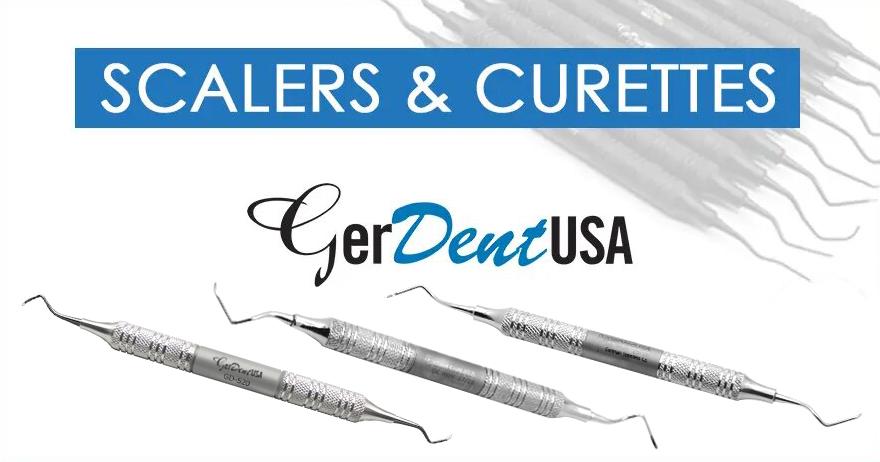
Scalers are essential instruments in dentistry. Scaling tools should hence be of high quality to provide excellent quality treatment. Scalers and curettes are instruments that come in use for removing subgingival and supragingival plaque and calculus from the surfaces of teeth and roots.
Poorly designed instruments perform inefficiently and consume loads of time for the operator. This makes the process inefficient and also sometimes may fatigue the hand of the operator. The quality, size, and type of the scaling instruments greatly determine the efficiency of the treatment. Other than that, it also determines the quality of the treatment provided to the patients.
Dental Curettes and Their Functions
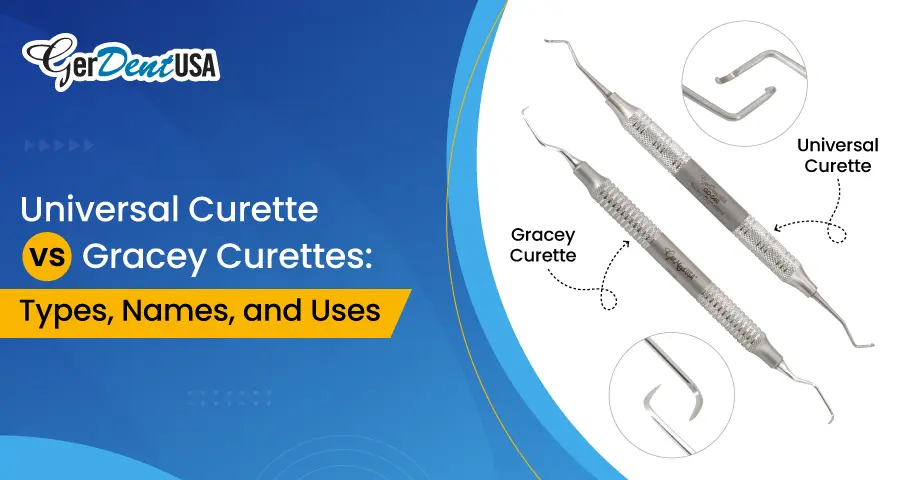
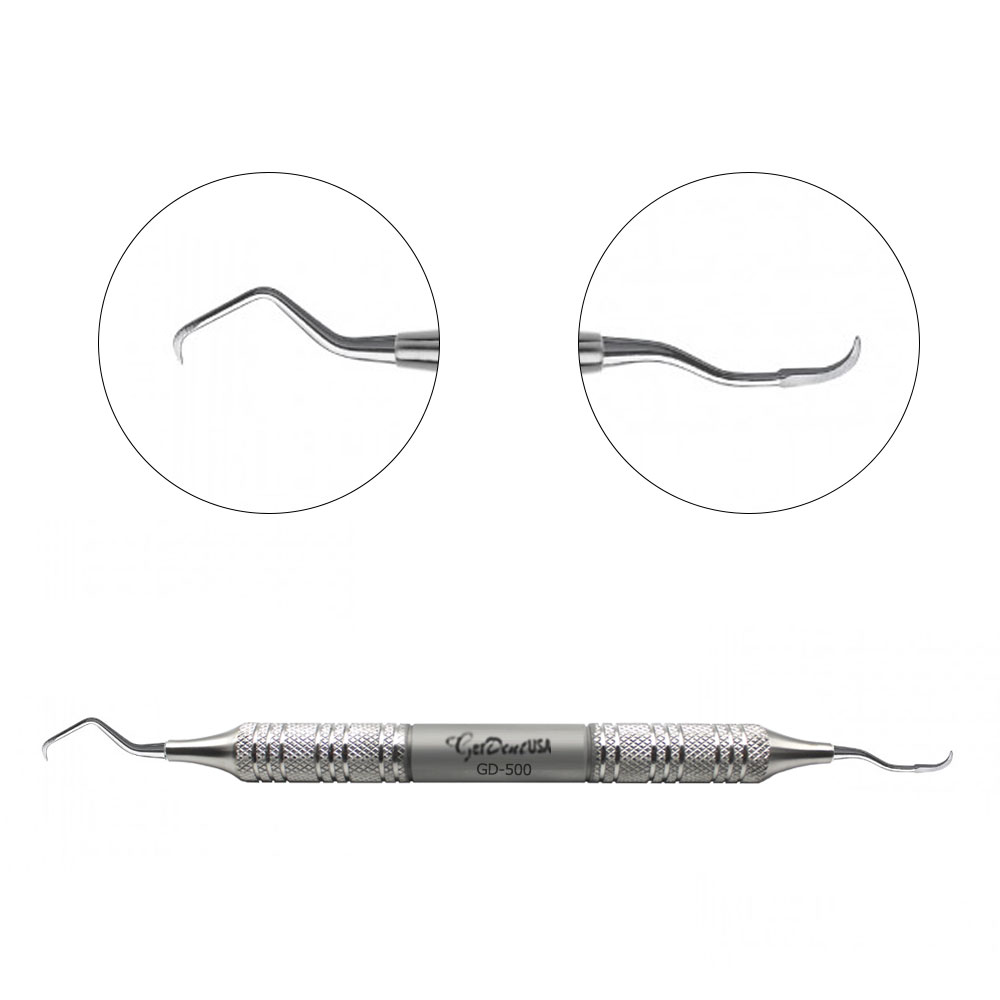
A curette is the type of instrument that comes in use for removing deep subgingival calculus. It also comes into use for root planning, removing altered cementum, and removing the soft tissues that line the periodontal pocket.
The cutting edge is on both sides of the blade and has a rounded toe. Curettes are finer than sickle scalers, and they do not have any other sharp points on their blades. Curettes can quickly go underneath the gingiva to pull out calculus with minimum soft tissue trauma.
In cross-section, the curette blade appears semicircular or spoon-shaped. Curettes are ideal instruments for subgingival scaling and root planning, as they adapt the best to complex root anatomy.
Types of Dental Curettes
1: Double-Ended Surgical Curette KN3/4
The KN3/4 curette is designed for post-extraction procedures and efficiently removes residual tissue from infected gingival areas. Its pointed, angled tips and rounded handle provide precise control and minimal trauma during cleaning.
Key Features:
• Rounded ergonomic handle
• Pointed angled tips
• German forged stainless steel
• Reusable and durable
Uses & Applications:
• Removal of infected gingival tissue after extraction
• Surgical curettage
• Post-extraction cleaning
2: Double-Ended Surgical Curette KRA3
KRA3 curettes are used for precise cyst removal and tooth socket debridement. Its extra-wide, sharp blades and double-ended design allow efficient cleaning while maintaining smooth contact with soft tissue.
Key Features:
• Double-ended design
• Extra-wide sharp blades
• Smoothly polished tips
• Angled working ends
Uses & Applications:
• Cyst removal
• Curettage
• Tooth socket debridement
3: Double-Ended Surgical Curette KRA2
KRA2 curettes offer excellent control for cyst removal and socket debridement. Its angled working ends and polished tips provide precision during surgical procedures.
Key Features:
• Double-ended design
• Extra-wide sharp blades
• Smoothly polished tips
• Angled working ends
Uses & Applications:
• Cyst removal
• Curettage
• Tooth socket cleaning
4: Double-Ended Surgical Curette KRA1
The KRA1 curette is ideal for surgical dental procedures requiring careful tissue removal. Its design ensures precision, efficiency, and minimal trauma to surrounding tissues.
Key Features:
• Double-ended design
• Extra-wide sharp blades
• Smoothly polished tips
• Angled working ends
Uses & Applications:
• Cyst removal
• Curettage
• Tooth socket debridement
5: Double-Ended Surgical Curette PR1/2
PR1/2 curettes are primarily used to remove granular tissue post-extraction. Its premium-grade stainless steel and rounded handles make it durable, comfortable, and reusable.
Key Features:
• Double-ended design
• Premium-grade stainless steel
• Reusable and durable
• Rounded ergonomic handle
Uses & Applications:
• Removal of granular tissue after extraction
• Curettage
• Post-extraction cleaning
6: Double-Ended Serrated Curettes
The serrated double-ended curette is crafted for efficient removal of granular tissue and cysts. Its textured handle provides excellent grip, and it is lightweight for minimal operator fatigue.
Key Features:
• Textured ergonomic handle
• Lightweight for easy handling
• German stainless steel
• Reusable after sterilization
Uses & Applications:
• Granular tissue removal
• Curettage
• Cyst removal after extraction
Scalers and Their Uses
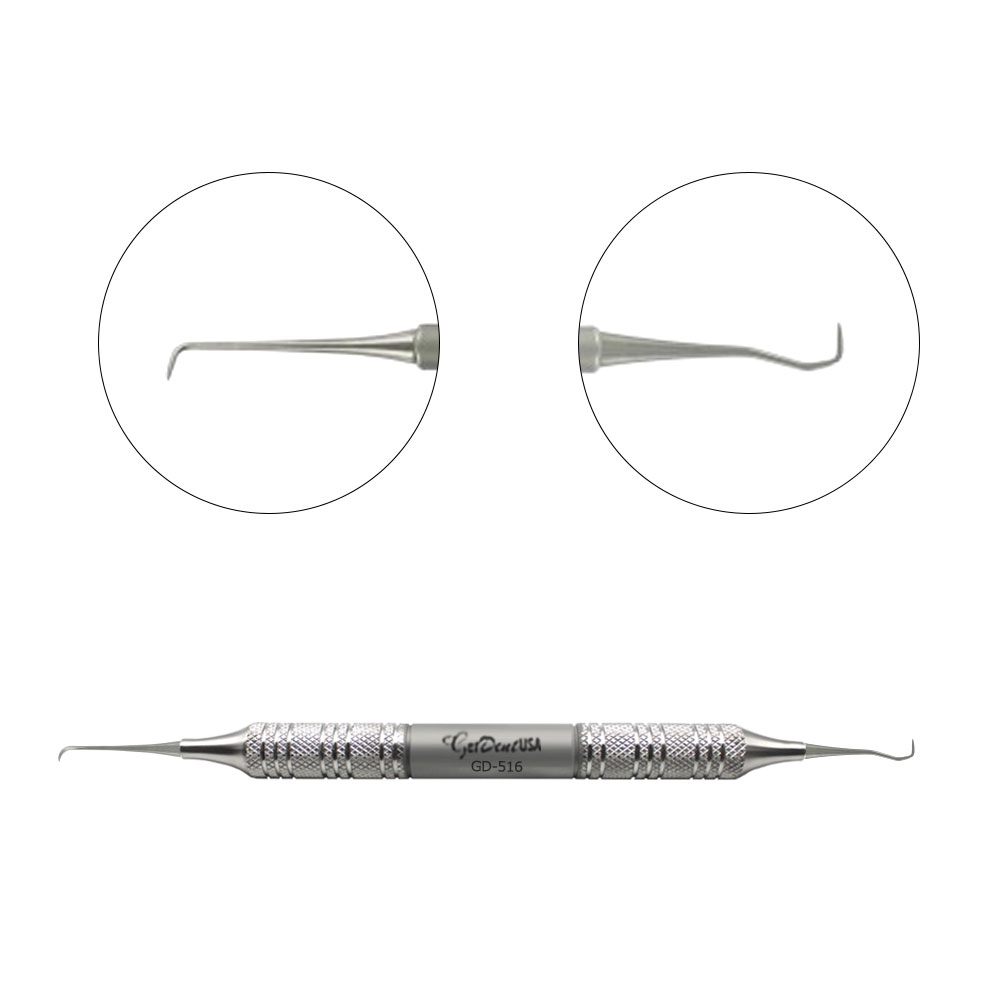
Sickle Scalers are instruments that come in use for removing supragingival calculus. Sickle scalers have a flat surface and two cutting edges that converge to form a tip. The shape of the instrument is such that the tip does not break off during use. The design of the instrument is such that it is difficult to insert it underneath the gingiva.
Hence the instrument cannot come in use for subgingival scaling. Sickle scalers with straight shanks come in use for scaling anterior teeth, scalers with angled shanks come in use for posterior teeth.
Scalers and curettes come in different shapes and sizes. Some examples of scaler curettes are Cattoni scaler curette and Goldman fox scaler curette.
Sharp scaler bites into the calculus better than a blunt one. Scalers need to be sharpened whenever they are dull, or they start sliding against the calculus. The cutting edges of the scalers are made sharp by use of an Arkansas stone. A few drops of oil or water are put on the stone so the instrument can slide on it quickly. The second and third fingers rest on the side of the stone. This is for better control of the instrument. The cutting edge is rubbed on the stone, and the instrument is moved back and forth to sharpen it.
Types of Dental Sickle Scalers
1: Crane Kaplan Scaler
The Crane Kaplan Scaler is designed for anterior teeth and provides excellent precision for removing plaque and light calculus. Its design allows easy access to tight interproximal spaces while minimizing stress on the operator’s hand during extended procedures. Ideal for detailed cleaning in cosmetic and routine treatments.
Key Features:
• Straight shank for precise control
• Pointed tip for accurate scaling
• Ergonomic, lightweight handle
• Durable stainless steel construction
Uses & Applications:
• Supragingival scaling of anterior teeth
• Light plaque and calculus removal
• Cleaning tight interproximal areas
2: Jacquette Sickle Scaler
Jacquette Sickle Scaler is perfect for delicate anterior scaling and detailed procedures. It allows dentists to remove plaque efficiently in small areas without causing hand fatigue, making it suitable for precision work in sensitive gumlines.
Key Features:
• Dual cutting edges for effective scaling
• Tapered ergonomic handle for comfort
• Lightweight and corrosion-resistant
• Smooth stainless steel finish
Uses & Applications:
• Precise anterior tooth scaling
• Supragingival plaque removal
• Delicate cleaning around gumlines
3: Morse Sickle Scaler
Morse Sickle Scaler is designed for small to moderate calculus deposits on anterior teeth. Its straight shank and sharp tip allow excellent tactile feedback, enabling the dentist to scale efficiently while maintaining precision in tight spaces.
Key Features:
• Sharp tip for fine scaling
• Straight shank for controlled movements
• Lightweight handle reduces hand fatigue
• Durable stainless steel for longevity
Uses & Applications:
• Anterior supragingival cleaning
• Light to moderate plaque removal
• Precision cleaning in tight spaces
4: Posterior Sickle Scalers
• Sickle Scaler
The standard Sickle Scaler for posterior teeth is a versatile instrument to remove supragingival deposits efficiently. Its angled shank provides access to molars and premolars, allowing the dentist to clean effectively in areas that are hard to reach with anterior scalers.
Key Features:
• Posterior supragingival scaling
• Cleaning molars and premolars
• Routine plaque removal
Uses & Applications:
• Angled shank for posterior access
• Dual cutting edges
• Ergonomic, lightweight handle
• Stainless steel construction
• Springfield Sickle Scaler
Springfield Sickle Scaler is designed to reach interproximal areas of posterior teeth. Its curved blade and balanced handle ensure precise scaling, even under challenging angles, while reducing operator fatigue. This makes it ideal for molars with heavy or moderate supragingival deposits.
Key Features:
• Curved blade tip for better access
• Balanced, lightweight handle
• Corrosion-resistant stainless steel
• Adapts easily to posterior surfaces
Uses & Applications:
• Interproximal posterior scaling
• Supragingival plaque and calculus removal
• Cleaning posterior molars efficiently
5: Taylor Sickle Scaler
Taylor Sickle Scaler is a heavy-duty posterior instrument for large supragingival deposits. Its sharp tip and angled shank allow efficient removal of stubborn calculus while maintaining comfort for the dentist during prolonged use. Ideal for both routine and intensive posterior cleaning.
Key Features:
• Angled shank for posterior access
• Sharp pointed tip for heavy deposits
• Ergonomic handle for comfort
• Durable stainless steel construction
Uses & Applications:
• Removing heavy posterior calculus
• Routine posterior scaling
• Efficient supragingival cleaning
Dental Sickle Scalers Vs. Dental Curettes: A Comparison Table
|
Feature |
Scikle Scalers |
Dental Curettes |
|
Primary use |
Supragingival scaling only |
Subgingival scaling, root planing, tissue removal |
|
Access |
Difficult for deep pockets |
Easily reaches under the gingiva and complex root anatomy |
|
Blade shape |
Triangular, pointed tip |
Semi-circular, rounded toe |
|
Cutting edges |
Two converging edges |
Two cutting edges on both sides of the blade |
|
Design types |
Anterior: Crane Kaplan, Jacquette, Morse Posterior: Sickle, Springfield, Taylor |
Double Ended: KN3/4, KRA1, KRA2, KRA3, PR1/2, Serrated |
|
Best for |
Removing visible plaque and supragingival calculus |
Deep subgingival scaling, root planing, and post-extraction tissue removal |
|
Soft tissue safety |
Higher risk if used subgingivally |
Minimal trauma due to the rounded toe and precise design |
|
Handle |
Ergonomic, tapered for reduced fatigue |
Ergonomic, rounded, textured, or smooth for comfort |
|
Material |
Stainless steel, lightweight |
German forged stainless steel, reusable, durable |
|
Clinical applications |
Anterior & posterior supragingival cleaning |
Subgingival scaling, curettage, cyst removal, and socket debridement |
Some factors you should keep in mind while selecting scaling tools for your clinic:
Ergonomic Handle Designs:
The scalers should come with ergonomic handle designs; otherwise, operator arm fatigue is possible if heavy cleaning is required in the clinic. Hence, the instrument grasp should feel comfortable to the operator.
Sometimes, suppose the scaler is heavy and is uncomfortable to the operator. In that case, there is a high chance that the operator may develop carpal tunnel syndrome, which, if left untreated, can cause problems in performing daily routine activities.
Good Material Quality:
The scaler has to be designed from good quality material that is lightweight and corrosion-free. Hence stainless steel products are the best quality products available in the healthcare market. The instruments are lightweight and robust. Another thing to keep in mind while selecting an instrument is that the instrument should not be made of a material harder than the tooth's enamel.
Lightweight Instrument:
The dentistry instrument should not fatigue the operator's arm while in use. The scaler may be in the operator's hand for quite some time if the calculus deposits are heavy. Hence scalers and curettes need to be lightweight to avoid fatigue. Heavy instruments require more excellent muscle activity and pinch force.
Handle Shape:
The instrument handle should be round and tapered. Tapered handles use lesser arm and pinch force in comparison to untapered handles. Hence, the handle of the instrument has to be tapered to avoid muscle fatigue.
All in all, the bottom line is that the operators should use tools that fit in their hands. Also, are efficient, versatile, comfortable, effective, and long-lasting.
Stainless Steel - Ideal Material for Instrument Manufacturing:
Instruments made from stainless steel are lightweight and durable; other than that, many other favorable stainless steel properties make it ideal for instrument manufacturing. Stainless steel is corrosion-resistant. It has high tensile strength, is extremely durable, has good formability, and is easy to fabricate. Besides that, stainless steel is low maintenance and has an aesthetic appearance, and above all, it is very environmentally friendly. It is reusable and hence is the best material for surgical instrument manufacturing.
Instrument Maintenance:
All surgical instruments need maintenance to ensure that they are fit for purpose and in good working condition before use. Other than that, instruments require time to time inspection to ensure that they are sharp, efficient, and always ready for use.
Dental surgical equipment should not be overused. Overuse causes their blades to get dull and their locks to malfunction.
GerDentUSA Inc. offer customization of dentistry instruments to our customers. Our expertise in surgical equipment manufacturing and supplying has made us one of the best in today's healthcare market. Some practicing doctors find traditional instruments hard to work with.
Hence, they are encouraged to come up with innovative designs for dental surgical equipment that, in the end, will benefit the healthcare industry today and in the future of denstistry.
Why Should You Buy From Us?
Choosing the right dental instruments is crucial, and GerDentUSA offers quality, reliability, and performance that professionals trust:
• High-Quality German Stainless Steel: Durable, rust-free, long-lasting instruments
• Wide Instrument Selection: Top dental curettes and sickle scalers for all needs
• Ergonomic Design: Lightweight and balanced to reduce hand fatigue
• Compliance & Sterility: Autoclave-safe and meets US medical standards
• Reliable Customer Support: Quick assistance and professional guidance
• Trusted Nationwide: Used by dentists and clinics across the US.
FAQ’s
What is the difference between a curette and a sickle scaler?
A curette is designed for subgingival scaling and root planning, while a sickle scaler is mainly for supragingival scaling.
Can a curette be used for anterior teeth?
Yes, universal curettes are suitable for both anterior and posterior teeth, while Gracey curettes are area-specific.
How often should scalers and curettes be sharpened?
Instruments should be sharpened whenever they become dull or slide against calculus, using an Arkansas stone with oil or water.
What material is best for dental scalers and curettes?
Stainless steel is ideal because it’s lightweight, durable, corrosion-resistant, and reusable.
What is the difference between a curette and a scaler in terms of soft tissue safety?
Curettes minimize soft tissue trauma due to their rounded toe and design, while sickle scalers can damage tissue if used subgingivally.
Do handle designs affect hand fatigue?
Yes, ergonomic, tapered handles reduce arm fatigue and pinch force, especially during prolonged procedures.
Are there area-specific curettes for difficult pockets?
Yes, Gracey curettes and mini curettes are designed for deep pockets, furcations, and complex root anatomy.
Can sickle scalers be used on posterior teeth?
Yes, posterior sickle scalers with angled shanks are designed for molars and other posterior teeth.
What is the difference between a sickle scaler vs. curette in clinical use?
Sickle scalers are for visible supragingival deposits, while curettes access subgingival areas and provide gentle root planing.
Why choose GerDentUSA instruments over other brands?
GerDentUSA provides high-quality German stainless steel, ergonomic designs, compliance with US standards, and professional customer support.