Every dentist knows that precision, efficiency, and patient comfort are non-negotiable when it comes to periodontal care. But when it comes to scaling and root planing, choosing the right curette can make all the difference.
In this guide, we’ll break down the Universal Curette vs. Gracey Curette, helping you understand their unique roles and uses, and why having the right instrument in your kit can transform your dental practice.
What Is a Curette in Dentistry?
A curette is a specialized dental instrument used for scaling and root planing, designed to remove plaque, tartar, and calculus from tooth surfaces. Curettes are essential in preventing periodontal disease and maintaining oral health.
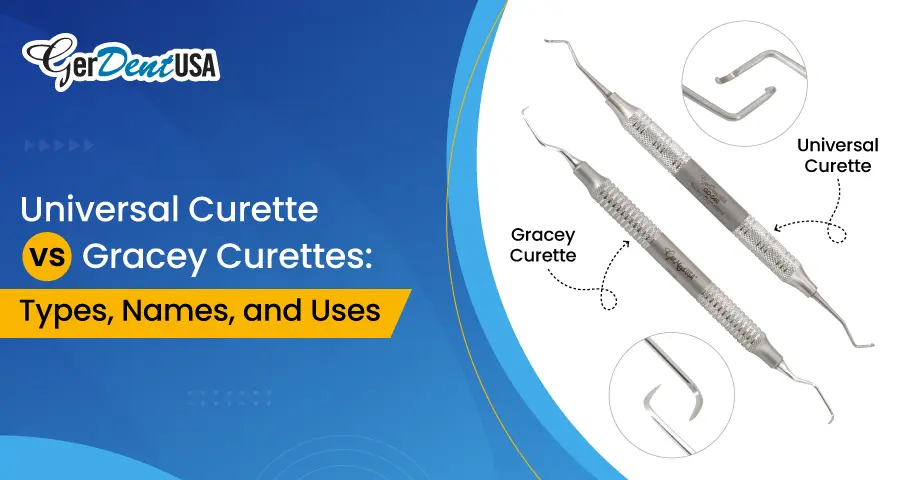
• Universal curette dental: Can be used on all tooth surfaces with minimal adjustment.
• Gracey curettes: dental instruments designed for specific teeth and surfaces, offering precise, targeted cleaning.
Universal Curette vs Gracey Curettes: Key Differences
|
Feature |
Universal Curettes |
Gracey Curettes |
|
Design |
Double-ended, straight blade for all surfaces |
Area-specific, angled blade for precise surfaces |
|
Use |
Can clean any tooth surface |
Tailored for specific teeth and surfaces |
|
Blade angulation |
90° to the terminal shank |
70° to the terminal shank |
|
Ideal for |
Beginners, general scaling |
Experienced practitioners targeted root planing |
|
Verstality |
Highly versatile |
Highly specialized |
|
Patient comfort |
Slightly less ergonomic in tight spaces |
Highly ergonomic, minimizes tissue trauma |
Types of Universal Curettes
Universal curettes are versatile instruments used in all areas of the mouth. Here’s a list of universal curettes with names and their uses:
|
No. |
Universal Curette Name |
Use |
|
1 |
Darby Perry, DP5/6 |
used to remove residual calculus after ultrasonic scaling for deep pockets |
|
2 |
BH5/6 Barnhart Universal Curette |
Helps dentists remove moderate to heavy calculus from all supra- and subgingival tooth surfaces. |
|
3 |
Barnhart Universal Curette BH1/2 |
Designed for removing debridements, calculus, and root planning. |
|
4 |
Universal Curette 17/18 Langer |
Helps periodontal surgeons remove calculus from the distal and mesial tooth surfaces. |
|
5 |
Universal Curette 5/6 Langer |
Ideal for scaling and root planing. |
|
6 |
Universal Curette 3/4 Langer |
Helps dentists remove moderate to heavy calculus. |
|
7 |
Universal Curette 1/2 Langer |
Specially designed for mandibular posterior teeth, both mesial and distal surfaces. |
|
8 |
Universal Curette ME1 |
Used for scaling and root planing procedures. |
|
9 |
Universal Curette 413/414 |
Useful for removing calculus and plaque from difficult-to-reach areas in the oral cavity. |
|
10 |
Universal Curette 411/412 |
Ideally used for curettage on all tooth surfaces. |
|
11 |
Rule Universal Curette 3/4 |
Designed to assist periodontists in clearing away both supragingival and subgingival calculus. |
|
12 |
Universal Curette BT13/14S |
Used in scaling and root planning procedures. |
|
13 |
Younger-Good Universal Curette 7/8 |
Designed for removing calculus and plaque from the subgingival area. |
|
14 |
Bunt Universal Curette 5/6 |
Designed for periodontal surgeons. |
|
15 |
Bunt Universal Curette 1/2 |
Used for removing calculus from all tooth surfaces. |
|
16 |
Universal Curette U17/18 |
Designed to assist periodontal surgeons in removing both supragingival and subgingival calculus. |
|
17 |
Universal Curette U13/14 |
Used for removing calcified material from mesial and distal surfaces in the oral cavity. |
|
18 |
Prophy Universal Curette GC7/8 |
Used to perform periodontal procedures, such as root planing and scaling. |
|
19 |
Prophy Universal Curette GC3/4 |
Designed for root planing and scaling procedures. |
|
20 |
Prophy Universal Curette GC5/6 |
Used while removing the calculus material from the dental cavity. |
|
21 |
Prophy Universal Curette GC1/2 |
Provides maximum hand control and helps prevent procedural complications during curettage. |
|
22 |
Mini Scraper / Curette Angled |
Used for removing tissue from narrow areas such as openings, apices, tissue punches, and the bone around implants. |
Types of Gracey Curettes
Gracey curettes are area-specific and allow precision scaling and root planing. Here’s a list of Gracey curettes with names and their uses:
|
No. |
Gracey Curette Name |
Use |
|
1 |
Gracey Deep Pocket Curette 3/4 Black Long |
Designed for scaling and root planing procedures. |
|
2 |
Gracey Deep Pocket Curette 3/4 Long |
Can perform both scaling and root planing. |
|
3 |
Gracey Curette, AF 1/2 |
Designed an area-specific curette. It is helpful for dentists in removing deep subgingival calculus. |
|
4 |
Standard Gracey Curette, GC 1/2 Titanium Coated |
Used for dentists to perform deep scaling, root planing, and remove periodontal debridement. |
|
5 |
Gracey Curette, Mini 0 |
Designed for dental hygienists to remove the calcified material from deeper subgingival margins. |
|
6 |
Gracey Curette, 12/13 Rigid |
Ideal for removing moderate to heavy calculus. |
|
7 |
Gracey Curette, AF 12/13 |
Specialized dental curettes that are used for subgingival scaling and root planing. |
|
8 |
Gracey Curette, AF 11/14 Rigid |
Used for removing calculus and plaque from the mesial surface of the teeth. |
|
9 |
Gracey Curette, AF11/14 |
Helpful in root planning and deep subgingival scaling. |
|
10 |
Gracey Curette, AF15/16 RIGID |
Used to access deeper subgingival calculus. |
|
11 |
Gracey Curette, AF15/16 |
suited for use on molars and premolars' mesial and distal surfaces. |
|
12 |
Gracey Curette, SAS13/14 |
Used to access the deep periodontal pockets and root surfaces of 5 mm or more. |
|
13 |
Gracey Curette, AF13/14 Rigid |
Designed a curette for removing moderate calculus and root debridement. |
|
14 |
Gracey Curette, AF 13/14 |
Used on molars and premolars' mesial and distal surfaces. |
|
15 |
Gracey Curette, SAS 11/12 |
Enables periodontal surgeons to access deep periodontal pockets and root surfaces. |
|
16 |
Gracey Curette, AF11/12 Rigid |
Effective in removing the deeper subgingival calculus. |
|
17 |
Gracey Curette, AF11/12 |
Used for removing calculus from the mesial and distal surfaces of molars and premolars. |
|
18 |
Gracey Curette, SAS7/8 |
Enables periodontists to access the deep periodontal pockets. |
|
19 |
Gracey Curette, AF 7/8 Rigid |
Designed to remove moderate calculus and perform root debridement. |
|
20 |
Gracey Curette, AF 7/8 |
Designed to be used on the distal and mesial surfaces of premolars and molars. |
|
21 |
Gracey Curette, SAS 5/6 |
Used to access the deeper gingival calculus with this thin blade current. |
|
22 |
Gracey Curette, AF 5-6 Rigid |
Commonly used for subgingival scaling and root planning. |
|
23 |
Gracey Curette, AF5/6 |
Designed for removing calculus, plaque, and other debris from the subgingival surface. |
|
24 |
Gracey Curette, SAS 3/4 |
Designed for removing calculus from the anterior teeth. |
|
25 |
Gracey Curette, AF3/4 RIGID |
Used for deeper insertion to remove subgingival calculus. |
|
26 |
Gracey Curette, SAS 1/2 |
An ideal curette designed for removing calculus, scaling, and root planning. |
|
27 |
Gracey Curette, Short Blade 1/2 |
Helpful for periodontal surgeons in removing deep subgingival calculus. |
|
28 |
Gracey Curette, AFGC 1/2 Rigid |
Designed to remove the subgingival calculus with greater precision. |
|
29 |
Gracey Curette, AFGC 1/2 |
Designed for the root planning and scaling of anterior teeth, including canines. |
|
30 |
Gracey Curette, GC 12/13 |
Helpful for periodontists in completing the entire facial or lingual sextant of posterior teeth. |
Why Choose Universal or Gracey Curettes?
• Universal Curette Uses: Ideal for general scaling, beginners, and all-surface cleaning.
• Gracey Curette Uses: Perfect for precision, root planing, and patient comfort in tight areas.
• Both are essential for any modern dental practice.
How to Use Universal Curettes
• Select the correct universal curette for the target tooth surface.
• Position the blade at 90° to the tooth surface.
• Use short, controlled strokes to remove calculus.
• Check for smoothness and absence of deposits.
How to Use Gracey Curettes
• Identify the Gracey curettes specific to the tooth surface.
• Angle the blade at 70° to the terminal shank.
• Perform gentle, precise strokes along the root surface.
• Ensure minimal trauma to the gingival tissues.
Why Should You Buy From GerDentUSA?
Choosing the right dental instruments isn’t just about functionality; it’s about confidence, consistency, and care for your patients. At GerDentUSA, every curette is thoughtfully designed to support precise clinical work while reducing hand fatigue and improving patient comfort.
When you invest in GerDentUSA, you’re choosing reliability that dental professionals trust every day.
• Premium Quality: Crafted for precision, durability, and enhanced patient comfort.
• Trusted Brand: Relied upon by dental professionals across the globe.
• Wide Selection: A complete range of Universal and Gracey curettes to meet every clinical need.
• Support & Warranty: Dependable customer service backed by product support you can trust.
Final Words
Choosing between a universal curette vs gracey curette depends on your clinical needs. Universal curettes offer versatility for everyday scaling, while Gracey curettes provide precision for targeted root planing. Both play an important role in effective periodontal care.
With GerDentUSA’s high-quality universal and Gracey curettes, dental professionals can work with confidence, improve patient comfort, and achieve better clinical outcomes. Investing in the right instruments today helps you deliver reliable, precise care every day.
FAQs
1. What is the difference between a Universal and Gracey curettes?
Universal curettes are versatile and work on all tooth surfaces, while Gracey curettes are area-specific and designed for precision in specific areas.
2. How do I choose between a Gracey and a Universal curette?
Consider your patient’s needs, tooth location, and your comfort. Beginners often start with Universal curettes, while experienced dentists use Gracey for targeted cleaning.
3. How to use Universal curettes?
Short, controlled strokes at 90° to the tooth surface remove plaque and calculus efficiently.
4. How to use Gracey curettes?
Angle the blade at 70° to the shank and perform precise strokes to clean specific tooth surfaces.
5. What are the types of Universal curettes?
Popular types include Columbia 13/14, Barnhart 5/6, and Universal 2R/2L, all designed for multi-surface cleaning.
6. What are the types of Gracey curettes?
Gracey curettes are area-specific, like 1/2 for anterior teeth, 11/12 for posterior mesial, and 13/14 for posterior distal.
7. Can Universal curettes replace Gracey curettes?
Not fully. Universal curettes are versatile but lack the precision for complex subgingival areas, which Gracey curettes handle better.
8. What are the main uses of Gracey curettes?
Scaling, root planing, subgingival cleaning, and precision plaque removal in tight areas.
9. What are the main uses of Universal curettes?
All-surface scaling, moderate to heavy calculus removal, and beginner-friendly periodontal care.
10. Why should dental professionals invest in quality curettes?
High-quality curettes ensure patient comfort, better clinical outcomes, and long-term durability for your practice.